
Thomas County Court Records After Arrest
After an adult arrest in Thomas County, the first public trail is often the Thomas County Sheriff's Office inmate roster. That roster is useful for current custody, booking number, booking date, booking charges, and bond notes. It is not the same thing as the filed court case. The official roster profile warning says charges and bail amounts may change after court appearances and tells people posting bail to call jail staff for correct charges, case numbers, and bond. That warning is the key local rule for Thomas County court records after a jail arrest.
The court trail runs through the Clerk of Superior, State, and Juvenile Courts, the Magistrate Court, State Court, Superior Court, the District Attorney, and the Solicitor General when a misdemeanor is in State Court. Booking details for custody belong on Thomas County jail inmate records, while routine booking-photo questions belong with Thomas County jail mugshots. A court record after an arrest is about the charge that was filed, the docket event, the bond order, the warrant status, and the final disposition.
The Thomas County Clerk page links to the official civil and criminal docket search for Superior and State Courts. It also points users toward e-certified document requests and e-filing channels. For older or hard-to-find court records, the GSCCCA Thomas County clerk profile says in-office computer searches cover Superior and State Court criminal and civil cases from present to 1989.
Note: A jail booking charge is a custody record, while a filed count in court is the case record to verify.
Find Thomas County Court Records
The main online channel is the Thomas County Superior and State Court docket portal. Static inspection did not expose the live search fields, so use the portal as a browser-based docket search rather than relying on guessed form labels. If the case is too new to appear, check the jail roster for the booking number and call the Clerk or jail for the correct case number route.
- Open the official docket portal linked from the Clerk of Courts page.
- Search with the defendant's name or case number when the portal allows it.
- Open the matching criminal case and compare names, case dates, and charge labels.
- Read each docket entry for charge status, bond orders, hearings, dismissal language, or disposition.
- For older cases or portal problems, use the Clerk's in-office search option for Superior and State Court cases back to 1989.
The Clerk's office is the record custodian for filed Superior and State Court criminal cases. The Clerk page lists office hours as Monday through Friday, 8 a.m. to 5 p.m., a mailing address at P.O. Box 1995, Thomasville, GA 31799, and a FedEx or UPS street address at 325 N. Madison Street, Thomasville, GA 31792. It also notes that personal checks are not accepted and that credit-card transactions have a convenience fee.
| Record Channel | Best Use | Thomas County Detail |
|---|---|---|
| Clerk docket portal | Filed criminal case and docket status | Official Superior and State Court civil/criminal docket search. |
| Clerk in-office search | Older or difficult cases | GSCCCA profile says criminal and civil searches run from present to 1989. |
| Jail roster | Current custody and booking charge | Shows booking number, date, charge label, bond field, and profile note. |
| Magistrate Court | Warrants and preliminary hearings | Handles arrest and search warrants, pre-warrants, and preliminary hearings. |
The official Clerk page shows how local court users reach the docket portal and document request options.
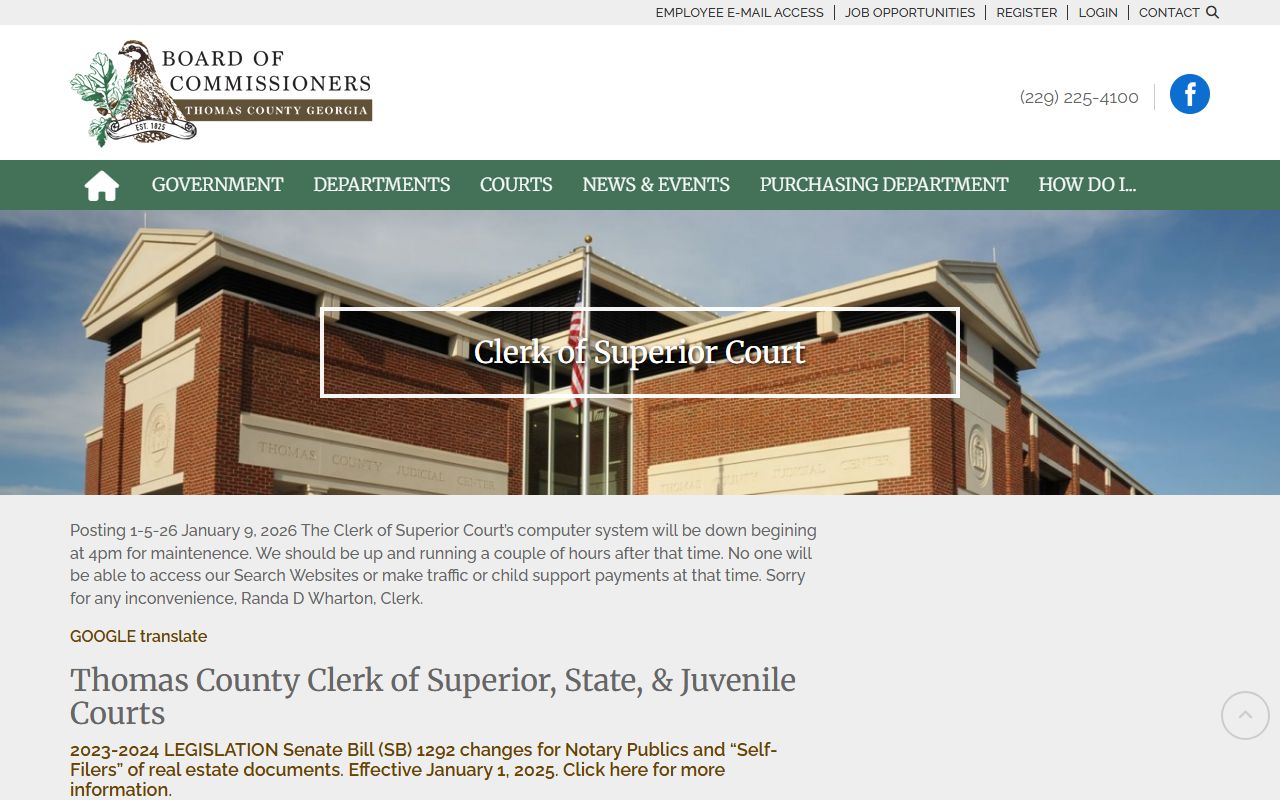
The screenshot matches the court-record pathway because the Clerk is the office that maintains Superior and State Court case records after an arrest.
Arrest to Court Pathway
A Thomas County arrest can move through several legal stops before the public docket is clear. Booking occurs at Thomas County Jail when local custody is required. For warrantless arrests, O.C.G.A. 17-4-62 requires the person to be brought before a judicial officer within 48 hours or released. That rule gives the first-appearance process a time limit, but it does not guarantee that every final court record appears online within that same period.
The Thomas County Magistrate Court handles applications for arrest and search warrants, preliminary hearings, county ordinance matters, and pre-warrants. State Court handles misdemeanor criminal cases. Superior Court handles felony cases and specialized tracks such as Felony Drug Court, Treatment and Accountability Court, and Veterans Court. The Thomas County District Attorney's Office prosecutes criminal offenses in the Superior Courts of the Southern Judicial Circuit, while the State Court page lists the Solicitor General for misdemeanor prosecution.
A simple flow is: arrest, jail booking, first appearance, warrant or preliminary-hearing review when needed, prosecutor screening, filed accusation or indictment, docket events, plea or trial, and disposition. The booking label can be short or broad. The filed court charge is the record to use for case status.
Thomas County Charging Documents
Charging documents explain why a court case exists after an arrest. Thomas County research did not locate a county-specific public field list for every document type, so the safest route is to search the docket first and then request copies from the Clerk if a document is needed. In Georgia criminal practice, a complaint, accusation or information, and indictment can play different roles. The docket will usually show the document name, filed date, charge count, and later status if the case has progressed.
| Document | Who Uses It | Plain Meaning |
|---|---|---|
| Complaint | Officer, court, or prosecutor process | Initial charge statement or sworn allegation tied to arrest or warrant review. |
| Accusation or information | Prosecutor | Formal charging paper often used to move a criminal case without a grand-jury indictment. |
| Indictment | Grand jury and prosecutor | Formal felony charging document returned after grand-jury review. |
The Thomas County District Attorney's Office page says prosecutions are generated primarily by police agencies operating in and around the jurisdiction. That wording matters because a jail booking may start with one agency, while the filed court record is screened and prosecuted through a court office.
Thomas County Charge Status
Charges can change after an arrest. A Thomas County jail roster entry may show a charge that is later amended, reduced, dismissed, or replaced by a formal court count. A bond field can also change after a first appearance or later hearing. The roster's own profile note says people should contact jail staff for correct bail amount, charges, and case numbers before posting bail. The court docket is the better source once the filed case exists.
| Status | What It Means | Where to Check |
|---|---|---|
| Pending | The charge or case is still open. | Clerk docket portal or Clerk office. |
| Amended | The filed count changed from the first version. | Docket entries and filed papers. |
| Reduced | The charge level or offense was lowered. | Docket and prosecutor filings. |
| Dismissed | The count or case was terminated without conviction on that charge. | Final court order or docket entry. |
| Nolle prosequi | The prosecutor declined to continue a charge. | Filed prosecutor action or docket notation. |
Note: A dismissal is not the same thing as automatic deletion from every public record system.
Bond After Thomas County Arrest
Bond is set through court authority but posted through the jail process. The Thomas County Sheriff's Office bonding page defines a bail bond as a written promise to appear in court. The page lists cash bond, professional bonding company, property bond, and transfer bond. It also states that the Sheriff's Office must charge a $20 non-refundable bond fee and that professional bonding companies are authorized to charge 15 percent.
| Bond Type | Thomas County Rule |
|---|---|
| Cash bond | Total face value plus required penalties in exact cash. The Sheriff's Office does not make change. |
| Professional bond | An approved bonding company posts the amount for a non-refundable fee. The sheriff lists companies without preference. |
| Property bond | All deed owners must appear with ID. A lien is placed on the property, and a form fee applies. |
| Transfer bond | Prepared in the property county, sealed, and delivered to Thomas County Jail the same day. |
| Hold or no-bond status | An ICE, probation, parole, other-county, or court hold may block release even after local bond review. |
Warrants and Court Records
No official public Thomas County active-warrant search form was located in the research. The strongest official warrant source is Magistrate Court, which handles applications for arrest and search warrants, preliminary hearings, and pre-warrants. The sheriff's Most Wanted page is an official fugitive channel, but it is not a complete warrant database. A person arrested on a warrant may later appear in the jail roster and then in a court docket if a criminal case is filed or reopened.
Failure to appear is a common point where jail records and court records meet. The inspected Thomas County roster sample showed a charge label for failure to appear in court as summoned. For a missed-court issue, search the Clerk docket, call the Clerk for court case details, call Magistrate Court for warrant or pre-warrant process questions, and call the jail for current custody or bond confirmation.
The Thomas County Magistrate Court page gives the local warrant and preliminary-hearing context.
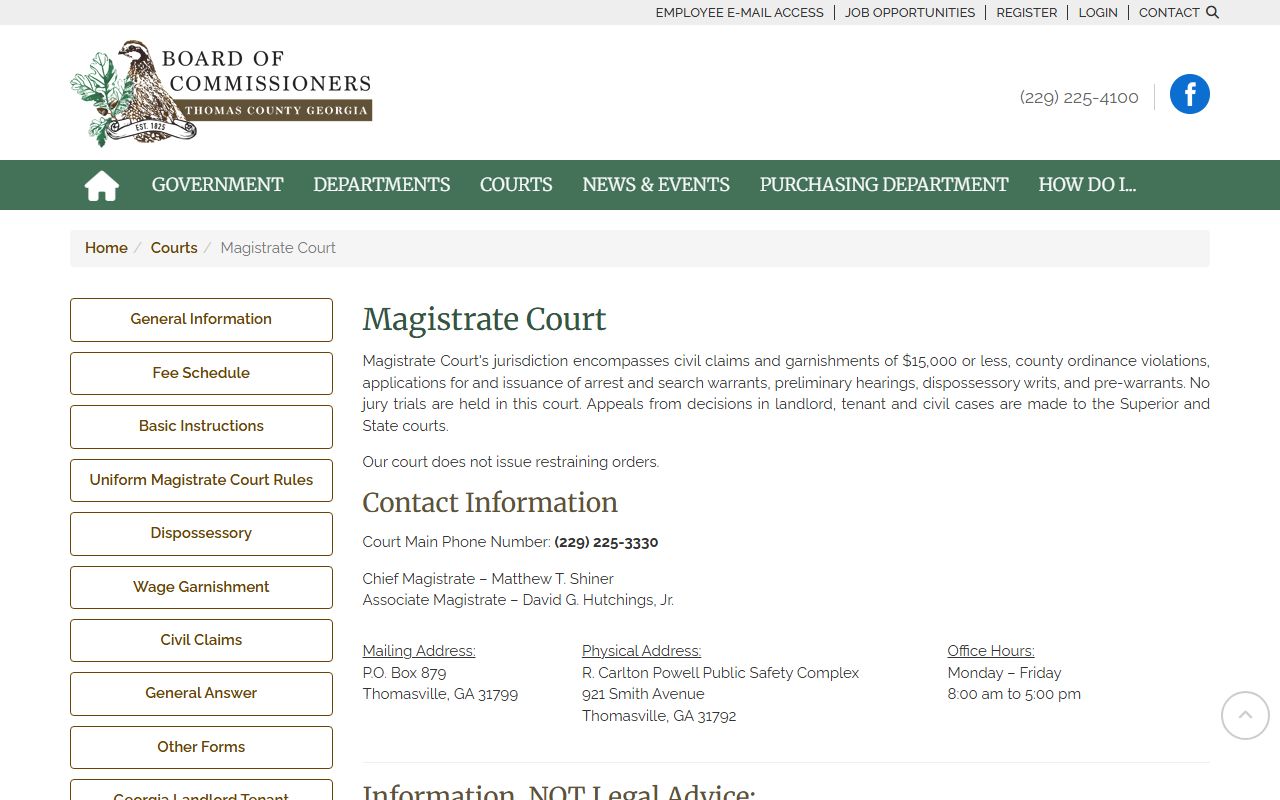
Because the same Smith Avenue public-safety complex is tied to jail and Magistrate Court functions, warrant questions often overlap with custody questions.
Charges vs Convictions
An arrest, a booking charge, a filed charge, and a conviction are different records. The Thomas County roster disclaimer and profile note support this distinction because they warn against treating roster details as certified legal facts. A charge is an accusation or filed count. A conviction follows a guilty plea, bench verdict, or jury verdict. A person can have a booking record and a court case without a conviction on the original charge.
| Point of Comparison | Charge | Conviction |
|---|---|---|
| Stage | Allegation, booking label, or filed count. | Final result after plea or verdict. |
| Source | Jail roster, warrant, prosecutor filing, or docket. | Court docket, judgment, sentence, or disposition. |
| Proof level | Probable cause or prosecutor decision. | Proof beyond reasonable doubt or admitted plea. |
| Best verification | Clerk docket and filed charging paper. | Final court disposition or certified copy. |
Restricted Thomas County Records
Georgia's Open Records Act, including O.C.G.A. 50-18-70, broadly favors access to public records unless a statute or court order limits release. Criminal court records can still have limits. Juvenile matters, sealed records, restricted criminal-history data, active investigative material, certain victim information, and records covered by a court order may not be available in the same way as a routine adult criminal docket.
The Georgia Attorney General's Open Government FAQ is useful for general public-record procedure, but court-specific access should start with the Clerk for filed cases and the sheriff for jail records. The Thomas County Clerk also manages Juvenile Court records, but juvenile detention and juvenile case data should not be treated as an adult jail roster or ordinary public booking file.
Public access rule: Georgia law favors public inspection of non-exempt records, but courts and agencies must withhold records protected by statute, court order, or juvenile confidentiality.
Sealed vs Expunged Records
Record cleanup after a Thomas County arrest is a court and criminal-history issue, not a jail counter task. The research did not identify a local sheriff process that automatically removes every booking reference after dismissal. Georgia uses record restriction and sealing concepts in ways that depend on the charge, disposition, court order, and criminal-history system. For a filed criminal case, start with the Clerk docket and any final order. Legal advice should come from counsel, not from the jail.
| Point of Comparison | Sealed or Restricted | Expunged or Removed |
|---|---|---|
| Public view | Hidden from ordinary public access or limited by rule. | Removed, deleted, or treated as unavailable where law allows. |
| Who acts | Court, clerk, criminal-history custodian, or agency. | Court or agency process authorized by law. |
| What survives | Some government access may remain. | Depends on the statute, order, and record system. |
| Best first step | Review the disposition and ask the Clerk about certified orders. | Confirm eligibility with counsel or the record custodian. |
Thomas County Prosecutor Roles
The prosecutor is not the main court-record custodian, but the office explains how charges move after an arrest. The official DA page lists Ray Auman as Senior District Attorney and gives the Judicial Center address at 325 North Madison Street with phone 229-226-6141. The page says the office prosecutes all criminal offenses, felonies and misdemeanors, plus certain civil matters such as drug, gambling, and bond forfeitures in the Superior Courts of the Southern Judicial Circuit.
State Court misdemeanor prosecution is separate in local court structure. The Thomas County State Court page lists Judge Mark E. Mitchell and Solicitor General Andrew W. Pope. If the issue is a filed docket, ask the Clerk. If the issue is a prosecution decision, victim notification, or case-status concern tied to the prosecution, the DA or Solicitor role may matter.
The Thomas County District Attorney page identifies the local prosecution office for criminal charges after many arrests.
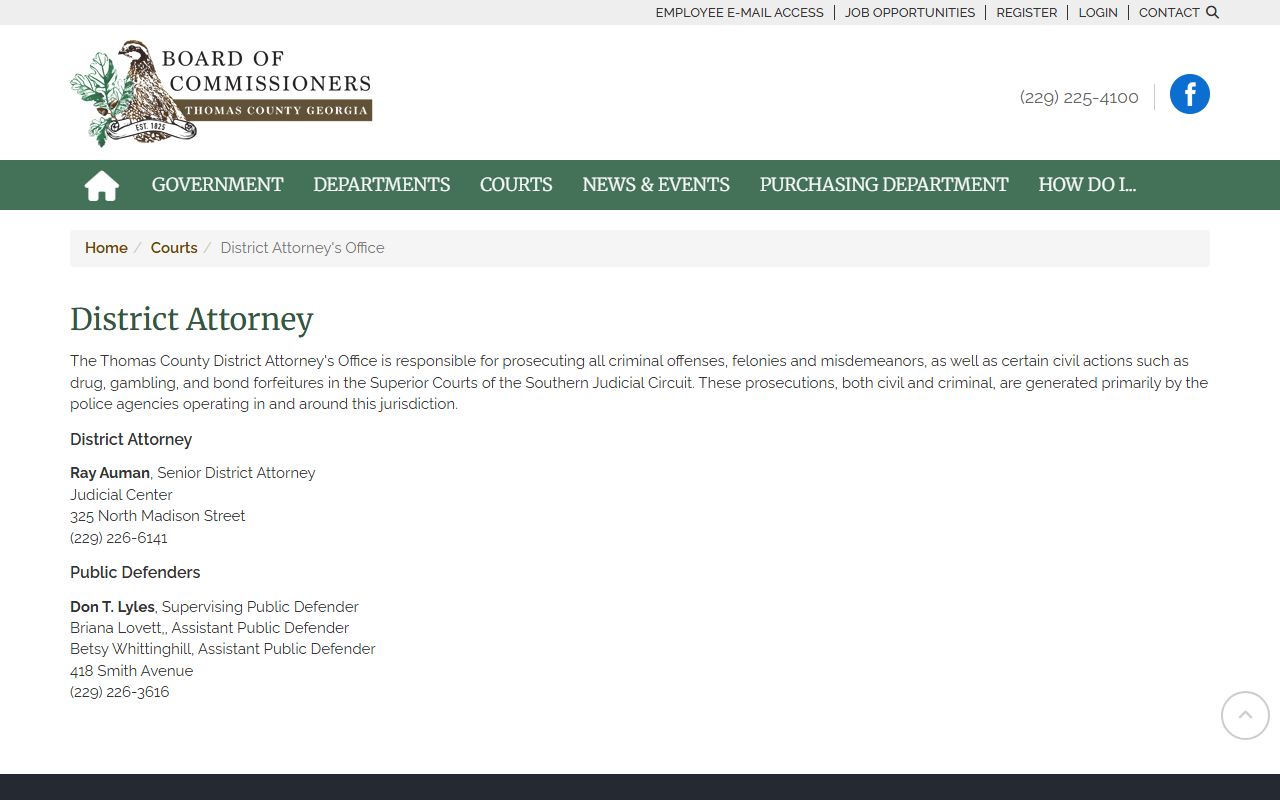
The DA office fits the court-record path because prosecutors screen and pursue charges after police agencies generate criminal cases.
Background Check Limits
Casual docket searches, jail roster checks, and warrant checks are not the same as a regulated background check. Court records after a jail arrest can be incomplete, delayed, amended, or restricted. Employers, landlords, insurers, lenders, and other regulated users must use lawful screening channels and comply with federal and state rules. A public jail or court lookup should not be used as the sole source for a decision that legally requires consumer-reporting safeguards.
Important: Public roster and docket data may be incomplete and cannot be used for employment, housing, credit, insurance, or other FCRA-covered screening.